

Why podcasts and pr are not the same.
PR commonly considers podcasts as part of press office, but they do not work the same as press.
Press coverage and podcast guesting often get bundled together under "PR" or "media" — but they do genuinely different jobs, and treating them as interchangeable just won’t work.
Press coverage is about visibility at scale, often quickly. A quote in a trade publication, a mention in a roundup of expert opinions — these reach a lot of people briefly, and they're valuable for credibility and SEO.
But podcasts work very differently.

Image credit: Adeolu Eletu
A podcast episode is a long-form conversation — usually 30 minutes or more — with an audience that's actively chosen to listen, often while commuting, exercising, or taking a long trip. That's a different kind of engagement than a scroll-past mention in an article.
This matters in a few ways, whatever sector you're in — law, healthcare, charity, gaming, government, or anywhere else.
The shelf life is longer. A press mention has a short window of relevance. A podcast episode often stays discoverable for years — see the example below when searching the term “layoffs”. Someone searching for advice on getting laid off in 2026, might find an episode recorded in last month, several months ago or in previous years. Still relevant, still bringing the right person to the right message at exactly the right moment.
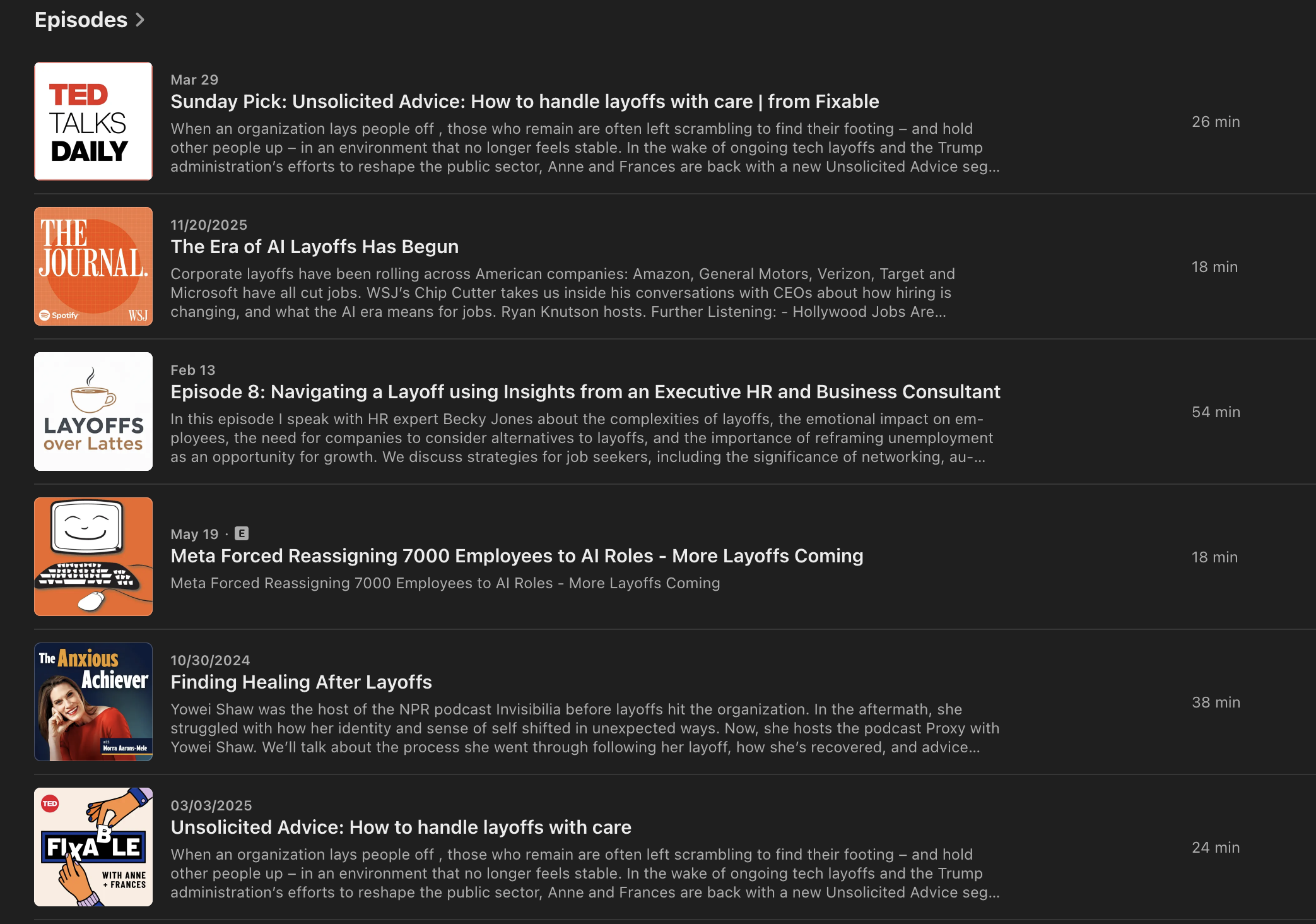
Screenshot searching the term layoffs on Apple Podcasts in summer 2026
Podcast schedules work differently. A press release can go out this week, in step with a campaign. Podcasts don't work that way. A show that publishes once or twice a month only has 12-24 guest slots a year. Good hosts book weeks or months in advance, because they're constantly filling their own pipeline and need time to prepare each conversation. Podcasts aren't chasing a news cycle; they're after evergreen content their audience will still value regardless of when they happen to listen. That means podcast guesting rarely fits neatly into a campaign timeline — it has to be planned on its own schedule, well ahead of when you'd want it to land. (Current affairs and politics shows are the exception, where time is sensitive and does matter.)
The audience is often more targeted. Trade press reaches broad industry audiences. A well-chosen podcast — focused on a specific topic, life stage, or community — reaches people who may genuinely need what you offer, at the moment they're thinking about it. Again, see the results above when searching layoffs.

Divorce lawyer James Sexton on Soft White Underbelly, YouTube 7.2 million views
It showcases people, not just organisations. Press quotes are short and impersonal. A podcast conversation lets someone be heard as a person — knowledgeable, approachable, human. That's hard to convey in a 50-word press quote or a few minutes on TV or radio. Certain experts go viral on podcasts for a reason - they’re human and people can relate. Personality wins every time. Consider the tattooed divorce lawyer who went viral on a podcast - an unbuttoned shirt and rolled up sleeves - sharing his personal opinion on love and marriage got him millions of views.
None of this means press coverage isn't valuable — it absolutely is, for different reasons. But if "media" gets treated as one bucket, podcasts may be judged on the wrong yardstick — reach and immediacy, when their real value is depth, longevity, and the relationships they can build with the right audiences over time.
Worth asking: are you considering podcasts as their own thing — or is it just tacked onto press office and sticking out like a sore thumb?